

Achieving Financial Independence: Experts Discuss Development of BRICS National Currency Settlements

How can BRICS countries move away from the dollar in international settlements, and what can they do to advance this goal today? These questions were discussed by experts during a round table at HSE University. The event was organised by the Multilateral Strategic Projects Office together with the HSE Faculty of World Economy and International Affairs as part of HSE’s activities within the BRICS Network University and the Joint Basic Research Projects ‘International Academic Cooperation of HSE University.’

Bruno de Conti
Despite efforts to introduce new currencies into international trade, the dollar is still used in 88% of transactions, noted Bruno de Conti, Professor of Economic Theory at the University of Campinas. This means that only 12% of transactions are conducted in national currencies. ‘The South African rand accounts for 1%, the Brazilian real has the same share, and due to sanctions, there are virtually no transactions in roubles. These figures are negligible compared to BRICS’ importance to the global economy,’ he said. Active steps to challenge the dollar’s dominance are being taken, particularly in China: the share of the Chinese yuan has risen from almost zero in 2007 to 7%. ‘There are bilateral initiatives within BRICS, and this is important especially now that BRICS is expanding,’ Bruno de Conti added.
He quoted Brazilian President Luiz Inácio Lula da Silva, who said in 2023 that he constantly wonders why all countries are forced to support the dollar instead of trading in their own currencies. According to the scholar, changing the situation requires addressing internal BRICS challenges—such as inertia and the difficulty of reconciling diverse national interests. Overcoming internal disagreements and strengthening digitalisation are essential steps forward.
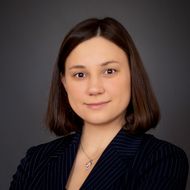
Alexandra Morozkina
Alexandra Morozkina, Associate Professor at the HSE Faculty of World Economy and International Affairs, noted that the use of BRICS currencies in international trade is expanding. The share of the yuan in China’s international trade increased from 15% in 2021 to 28% in 2024. ‘The share of the rouble in total Russian exports grew from 12% in 2022 to 41% in 2024,’ she said. In 2023, a landmark deal took place: the yuan was used for the first time to settle oil transactions between the UAE and China. Increasing the liquidity of national currencies is a step towards de-dollarisation, and BRICS is gradually building the necessary infrastructure for it. ‘The BRICS Grain Exchange is also a step towards setting prices in BRICS currencies,’ Alexandra Morozkina explained.

Alexey Ponomarenko
Alexey Ponomarenko, Professor at the HSE Joint Department with the Bank of Russia, presented a concept for creating a closed international settlement system and discussed in detail models for such settlements, using the Mariana Project as an example. He pointed out that in designing such a system, the requirements for a single technical settlement unit are minimal, meaning that no specific changes to the monetary systems of participating countries would be necessary. Prof. Alexey Ponomarenko emphasised the importance of automatically determining exchange rates—a mechanism that could naturally regulate payment flows.
The round table was moderated by Olga Biryukova, Associate Professor at the HSE Faculty of World Economy and International Affairs. Anastasia Vyskubina, Head of the Online Project Support Department at HSE University, also took part in the discussion.

See also:

HSE Graduate School of Business and Alfa-Bank Hold Summer School for Students from China
Twenty-seven students from Chinese universities took part in the international summer school ‘Digital Product Management’ organised by the HSE Graduate School of Business and Alfa-Bank. Over the course of a week, participants explored the Russian economy and business environment, learned about current technology trends, and worked through the key stages of digital product development step by step—from researching user needs and defining a problem to developing a prototype and presenting their final project.
Physicists Discover What Happens Inside a Stable Vortex
Large vortices with characteristic spiral arms are often observed in the atmosphere and the ocean. Physicists from HSE University have explained how these structures form and why they retain their shape. The researchers found that velocities at points located along the same vortex arc remain correlated even over long distances. At the same time, this correlation weakens rapidly with increasing distance from the vortex centre. These differences help explain the formation of spiral arms and may improve models of atmospheric and oceanic currents. The findings have been published in Physical Review Fluids.
‘The Peak of Stupidity’ and ‘The Valley of Despair’: HSE Economists Propose an Explanation for the Dunning–Kruger Effect
The Dunning–Kruger effect, which describes a sharp surge in self-confidence among beginners followed by an equally rapid decline as they gain experience, can be explained by the nature of the learning process and the acquisition of new knowledge. This conclusion was reached by Andrey Vorchik of the HSE Faculty of Economic Sciences together with independent researcher Murat Mamyshev. They developed a mathematical model of learning and demonstrated how subjective confidence is formed and changes as knowledge accumulates, as well as how teachers can reduce the ‘valley of despair’ experienced by learners.
Advancing Collaboration: HSE Faculty of Computer Science and Harbin Institute of Technology Hold Joint Seminar
From July 13 to 16, 2026, the Faculty of Computer Science hosted the Russian–Sino Research Seminar on Machine Learning Applications, organised by the HSE Laboratory for Cloud and Mobile Technologies in partnership with the Harbin Institute of Technology (China). A delegation comprising seven students and three university representatives travelled to Moscow to take part in an intensive four-day programme.
HSE and Karakalpak State University Agree on Cooperation
HSE University and Berdakh Karakalpak State University have signed a cooperation agreement to strengthen collaboration in research, education, and innovation. Through the expertise of its Сentre of Digital Technologies for Nature-Based Solutions of the Carbon Measurement Supersites Programme, HSE University will work with colleagues from Uzbekistan to assess climate risks and evaluate opportunities for implementing nature-based climate projects in the region. The partners also plan to develop joint research and educational programmes.
‘We Are Always Open to Collaboration, and China Is One of Our Most Important Partners’
From July 20 to 27, 2026, the HSE Faculty of Urban and Regional Development (FURD) is hosting a summer school for students from Tianjin University dedicated to the preservation of cultural heritage. Throughout the week, participants have attended lectures, practical workshops, and field visits to some of Moscow’s most iconic heritage sites. The summer school is the faculty’s first international programme of this kind and forms part of the expanding educational cooperation between Russia and China.
Physicists at HSE University and FIAN Discover Way to 'Photograph' Sound for Testing Materials Used in 6G Communications
Researchers at HSE University, in collaboration with colleagues from the Lebedev Physical Institute of the Russian Academy of Sciences (FIAN), have developed a method for rapidly determining how firmly a film is bonded to a substrate. This is important for the creation of ultrahigh-frequency acoustic filters, which are key components of next-generation 5G and 6G communications. For the first time, researchers have succeeded in measuring the lateral rigidity of the bond between a two-dimensional material film and a substrate in this way. The study results have been published in Applied Physics Letters.
HSE University and Peking University Expand Their Partnership
Peking University President Gao Song paid his first visit to HSE University as part of his first overseas trip since taking office in May 2026. The main purpose of the talks was to consolidate existing areas of cooperation and expand joint projects between HSE University and Peking University within the framework of the Cross Years of Russia–China Cooperation in Education (2026–2027).
BRICS Launches Joint Study on Competition in Global Grain Trade
At the UN Trade and Development (UNCTAD) headquarters in Geneva, experts and representatives of competition authorities and international organisations discussed competition in the global grain trade. The discussions resulted in the establishment of a BRICS project task force that will prepare the bloc’s first joint sectoral study of the grain market. The initiative was presented by the BRICS Competition Law and Policy Centre based at HSE University.
Biologists Discover Unique Properties of MiR-93-5p MicroRNA in Prostate Cancer
Researchers at the International Laboratory of Microphysiological Systems of the HSE Faculty of Biology and Biotechnology investigated how different isoforms of the same microRNA influence gene function in prostate adenocarcinoma. The study found that in some cases, microRNAs can reinforce each other’s effects by targeting and suppressing the same genes. This finding offers a fresh perspective on the molecular mechanisms underlying tumour development and on the search for disease biomarkers. The results have been published in PeerJ.